Solar Financing Options: What Works Best for Your Home or Business?
Solar power is no longer a luxury reserved for large corporations. Indian homeowners, small business owners, and growing enterprises are switching to rooftop solar to escape rising electricity bills. The challenge is that a quality solar system still costs anywhere between ₹1 lakh and ₹15 lakh depending on size, which is where smart solar financing makes all the difference.
Here are the most relevant solar system financing options in India for both residential and commercial users.
Why Financing Solar Makes Sense
Paying for a solar system entirely upfront is rarely practical, and it is rarely necessary. A solar loan allows you to:
- Spread the cost over 3 to 10 years.
- Begin saving on electricity bills from the very first month.
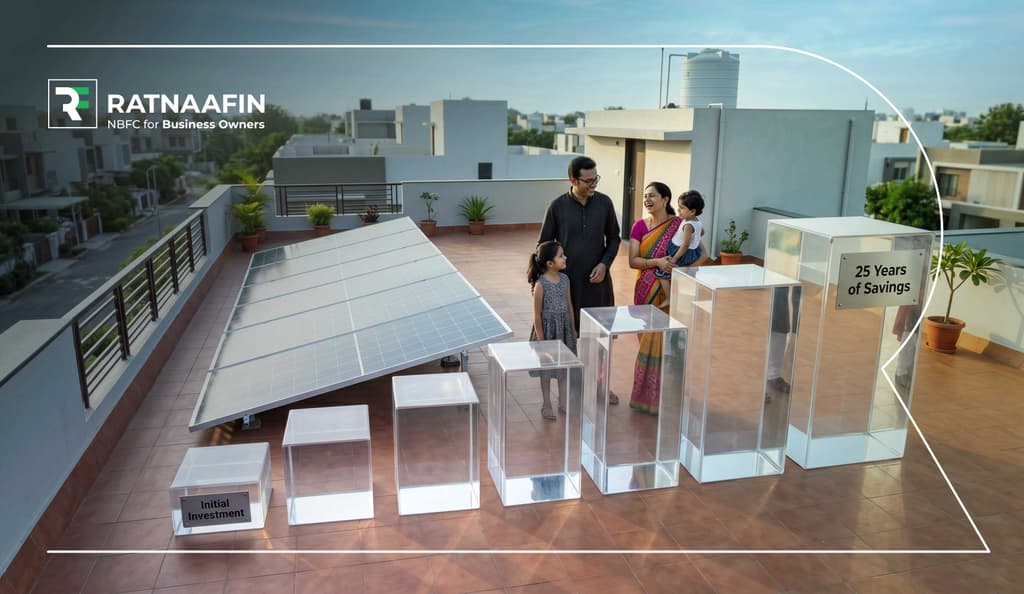
- Use those savings to cover the EMI, often making the system effectively self-funded.
- Preserve your savings and emergency reserves for other priorities.
In many cases, the EMI is lower than the existing electricity bill, which is why solar financing has gained strong traction across India.
Top Solar System Financing Options in India
Each option suits a different borrower profile and system size.
1. Dedicated Solar Loan
A Solar Loan is a purpose-built financing product designed specifically for rooftop solar installations. With backing from government schemes like the PM Surya Ghar Muft Bijli Yojana, Solar Loans come with attractive interest rates and longer tenures.
Best for: Homeowners and small businesses installing systems up to 10 kW.
Typical solar financing rates: As low as 6.75% to 10.5% under priority sector lending.
2. Loan Against Property (LAP)
If you own residential or commercial property, you can pledge it to access a higher loan amount at a more competitive rate. LAP is well suited for high-capacity solar systems and longer tenures.
Best for: Business owners or property holders installing rooftop systems above 10 kW.
3. Business Loan
A Business Loan is ideal for shops, manufacturing units, hotels, and offices looking to reduce long-term operating costs through solar. The interest paid is typically tax-deductible as a business expense, while accelerated depreciation on solar assets adds further tax efficiency.
Best for: Established businesses ready to lower monthly utility costs.
4. Working Capital Loan
For enterprises that prefer not to dip into operational reserves, a Working Capital Loan helps fund a solar installation without disturbing day-to-day cash flow.
Best for: SMEs and businesses managing seasonal cash flow cycles.
5. Machinery Loan
When solar is part of a larger industrial setup, including inverters, batteries, and integrated systems, a Machinery Loan can finance the entire equipment package as a productive asset.
Best for: Manufacturers and industrial units integrating solar with operations.
6. Revenue-Based Funding
Businesses with steady cash inflows can opt for Revenue-Based Funding, where repayments scale with your revenue, ideal for solar projects with predictable energy savings.
Best for: Growing businesses seeking flexibility over fixed EMIs.
How to Choose the Right Solar Financing Option
Your choice depends on three key factors:
- Use case: Residential vs. commercial installation.
- System size: Smaller setups suit Solar Loans; larger installations align better with LAP, Business Loans, or Machinery Loans.
- Repayment comfort: Shorter tenures cost less in total interest but raise the EMI.
A useful rule of thumb: if your monthly electricity bill exceeds ₹3,000, financing a solar installation is almost always financially sound.
What to Watch Out For
Before finalising any solar loan, review:
- The interest rate type (fixed vs. floating).
- Processing fees and prepayment charges.
- Whether the lender is empanelled under the relevant subsidy scheme.
Total cost of ownership across the loan tenure.
Final Thoughts
Solar is no longer just an energy choice, it is a long-term financial investment. The best solar financing aligns with your budget, goals, and repayment comfort. At Ratnaafin, we help individuals and businesses across India choose the right solution, whether it is a Solar Loan, LAP, Business Loan, Working Capital Loan, or Revenue-Based Funding, so adopting solar feels seamless and financially smart.
Frequently Asked Questions
- ₹50,000 to ₹3.5 lakh: CIBIL-based program
- ₹3.5 lakh to ₹10 lakh: ABB-based program
The final sanctioned amount depends on your credit profile, repayment capacity, and Ratnaafin's assessment.
- Under Ratnaafin's policy:
- CIBIL score 700 or above: Up to 100% of the quotation value (inclusive of subsidy amount)
- CIBIL score 650 to 699: Up to 90% financing
- CIBIL score -1: Up to 80% financing
The final loan amount is determined after credit evaluation and policy checks.
- Whether you're installing a residential or commercial solar system.
- The total project cost and required loan amount.
- Your monthly repayment capacity.
Your credit profile and eligibility